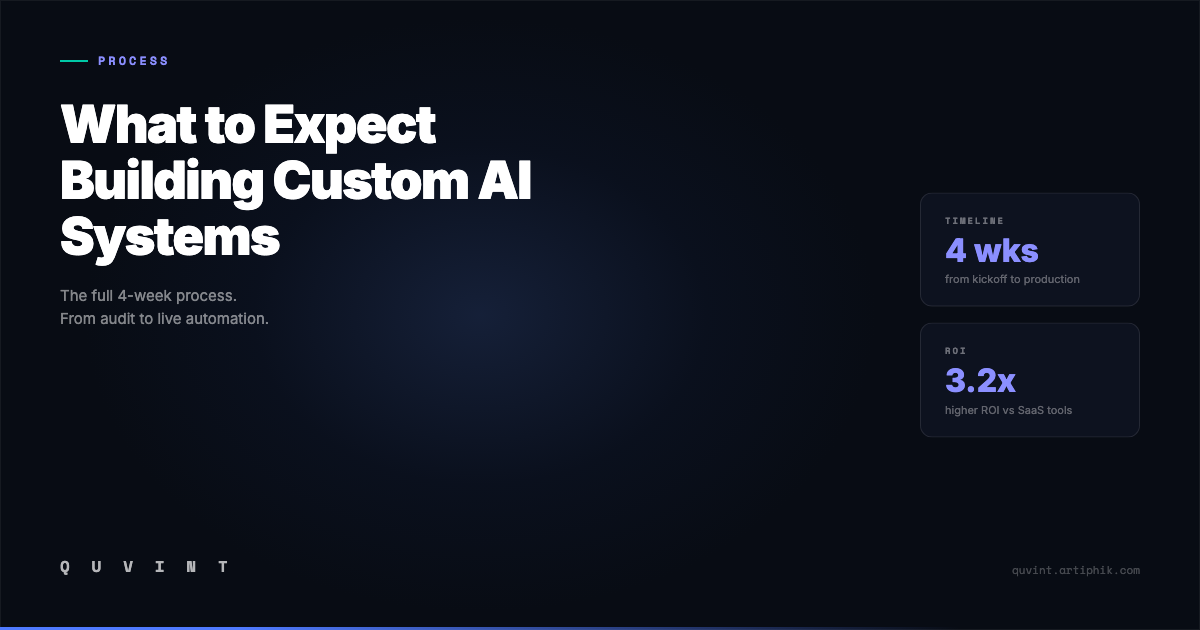
The biggest reason marketing teams do not invest in custom AI is not the price. It is the unknown. They have no idea what the process looks like, how long it takes, what they need to provide, or what they actually get at the end. That uncertainty kills deals more than budget objections ever will.
We build custom AI marketing systems for teams every month. And the number one question we get on discovery calls is some version of “So… what actually happens after we say yes?”
This post answers that question completely. Week by week. Deliverable by deliverable. No vague promises, no hand-waving about “AI transformation.” Just the actual process, so you can decide if it is right for your team with full clarity.
Before We Start: The Discovery Call
Everything begins with a 30-minute call. This is free. No commitment.
On this call, we are trying to understand three things:
-
What your team actually does every day. Not the job titles. The real work. Who writes content? Who schedules posts? Who pulls reports? Who edits designs? Where do hours disappear?
-
What tools you are already using. Your CMS, your social scheduler, your analytics platforms, your CRM. We need to know what already exists before we build anything.
-
Where the pain is. Usually it is one of three things: your team is drowning in repetitive work, your content output cannot keep up with demand, or your tools do not talk to each other and everything requires manual glue.
If there is a fit, we send over a proposal within 48 hours. The proposal includes exactly which workflows we will automate, the timeline, the price, and projected time savings. No surprises later.
The 4-Week Build Process
Every engagement is different, but the structure is consistent. Here is what happens week by week.
Week 1: Discovery and Audit
Your time commitment: 2 hours
This is where we go deep on your workflows. We review your entire marketing stack, analyze where time is being lost, and identify the highest-impact automations.
What happens:
- We audit every tool in your stack and how they connect (or do not connect)
- We map your team’s workflows step by step, from content ideation to publishing to reporting
- We identify the top 5 time sinks that AI can eliminate or dramatically reduce
- We collect your brand assets: voice guidelines, content examples, design templates, tone references
What you get at the end of Week 1:
- A detailed “AI Automation Roadmap” document showing exactly what we will build
- ROI projections: estimated hours saved per week for each automation
- Architecture diagram showing how the new system connects to your existing tools
- Priority ranking so we build the highest-impact automations first
Most teams are genuinely surprised by this document. They know things are slow, but they have never seen the inefficiency quantified. Seeing that your team loses 22 hours per week to tasks AI can handle changes the conversation fast.
Week 2: Architecture and Prototyping
Your time commitment: 30 minutes
This is where we design the system architecture and build the first working prototypes. Your team gives one round of feedback on the architecture, and then we start building.
What happens:
- We design the system architecture: what each automation does, how they connect, where data flows
- We build the first prototype of your highest-priority automation
- We configure brand voice training using your existing content library
- We set up the integration layer connecting your existing tools
What you get at the end of Week 2:
- A working prototype of your first automation (usually content generation or reporting)
- Demo of the system producing real output using your brand voice
- Confirmation that the architecture works with your existing stack
- Adjustment notes if anything needs to change before full build
The prototype is important. It is the first time you see AI output that actually sounds like your team. Not generic. Not robotic. Content that matches your voice because the system was trained on what your team has already written.
Week 3: Full Build and Integration
Your time commitment: 30 minutes
This is the heaviest week on our end. We build out all remaining automations, connect every integration, and start running the full system end to end.
What happens:
- We build all 3 to 5 automations in the package
- We connect every integration: CRM, analytics, social platforms, CMS, email tools
- We configure automation triggers so workflows run on schedule or on demand
- We run full end-to-end tests with real data from your accounts
- We fine-tune the brand voice model based on prototype feedback
What you get at the end of Week 3:
- A fully built system running in a staging environment
- All automations connected and tested
- Output samples from each automation for your review
- List of any final adjustments before going live
By the end of this week, the system is essentially done. It is generating content in your voice, pulling analytics from your platforms, automating your social engagement workflows, and producing reports that used to take hours. The final week is about making sure everything is bulletproof before your team starts using it daily.
Week 4: Testing, Training, and Handoff
Your time commitment: 1 to 2 hours
This is where your team gets hands-on. We train them on every automation, walk through the documentation, and make sure they are confident using the system independently.
What happens:
- We run stress tests on all automations to make sure they handle edge cases
- We create complete documentation for every workflow
- We record video walkthroughs for each automation
- We conduct a live training session with your team
- We hand over full system access and ownership
What you get at the end of Week 4:
- A fully operational AI marketing system running in production
- Complete documentation (written guides and video walkthroughs)
- Full ownership of everything, all code, configurations, and data
- 2 weeks of post-launch support included for any issues or questions
- Optional: ongoing optimization proposal if you want the system to keep evolving
Your team walks away with a system they own completely. No subscription fees. No vendor lock-in. No dependency on us to keep it running. The system is yours.
What the Before and After Actually Looks Like
Numbers tell the story better than descriptions. Here is what a typical engagement delivers, based on real client results.
| Metric | Before Custom AI | After Custom AI |
|---|---|---|
| Content production time | 8 to 12 hours/week | 2 to 3 hours/week |
| Weekly reporting | 4 to 6 hours/week | 15 minutes (automated) |
| Social media management | 6 to 10 hours/week | 1 to 2 hours/week |
| Content pieces per week | 3 to 5 pieces | 12 to 20 pieces |
| Brand voice consistency | Varies by writer | Consistent across all output |
| Tool stack cost | $800 to $2,000/month in SaaS | $50 to $200/month (API + hosting) |
Hours per week saved on average across all client engagements. That is the equivalent of hiring a half-time marketing coordinator, without the salary, benefits, or management overhead.
QUVINT Client Data, 2026What You Need to Provide (and What You Do Not)
One of the biggest anxieties we hear is “We probably don’t have our stuff together enough for this.” So let us be specific about what we actually need from you.
What we need:
- Access to your existing marketing tools (analytics, CMS, social accounts)
- Your brand guidelines, if you have them (even a rough style guide works)
- 10 to 20 examples of content your team has produced (blog posts, emails, social captions)
- 3 to 5 hours of your team’s time across the full 4 weeks
What I do NOT need:
- A perfectly documented operations manual
- Technical expertise on your team
- A dedicated project manager
- Any coding or prompt engineering knowledge
- An existing AI strategy
I work with teams that have never touched AI before. That is completely normal and honestly the most common scenario. You do not need to be “AI ready” in any technical sense. You just need to know what your team does every day and be willing to let a system handle the repetitive parts.
What Happens After Handoff
Once the system is live, you have two paths.
Path 1: You run it independently. The system is yours. Documentation is complete. Your team is trained. You use it, maintain it, and evolve it on your own. Plenty of teams choose this path, and the system keeps delivering value for months and years without any involvement from me.
Path 2: Ongoing optimization. Marketing is not static. Your campaigns evolve, new platforms emerge, your team’s needs change. Ongoing optimization means I keep improving the system monthly, building new automations as opportunities appear, and making sure your AI keeps compounding in value.
Most teams start with Path 1 and move to Path 2 after a few months, once they see the ROI and want to expand. But there is zero pressure either way. The build stands on its own.
The Investment
Transparency matters, so here are the real numbers.
AI Readiness Audit: $2,500. One week. You get the roadmap and ROI projections even if you decide not to build.
System Build: $5,000 to $10,000 depending on the number of automations. 3 automations start at $5,000. Full stack builds with all 8 automation types run $10,000.
Ongoing Optimization: $2,000 to $5,000 per month. Optional. No minimum commitment.
For context, a single mid-level marketing hire costs $60,000 to $90,000 per year. A custom AI system that saves your team 20+ hours per week costs a fraction of that, and it never takes vacation, never calls in sick, and never needs to be re-trained when someone quits.
Common Concerns (Answered Honestly)
“What if the AI output is not good enough?”
That is what Week 2 prototyping is for. You see real output from the system before we build the rest. If it does not meet your standards, we adjust. You are never locked into a system that produces mediocre work.
“What if our workflows change after the build?”
They will. That is normal. The system is designed to be modular. Individual automations can be updated, replaced, or expanded without rebuilding the entire system. If you are on the ongoing plan, we handle this automatically.
“What if we want to stop using it?”
You own everything. Turn it off whenever you want. There is no subscription to cancel, no data held hostage, no exit fee. It is your system on your infrastructure.
“Do we need to change how our team works?”
Minimal changes. The system is built around your existing workflows, not the other way around. Your team keeps using their familiar tools. The AI runs behind the scenes, handling the repetitive work that used to eat their hours.
Is This Right for Your Team?
This process works best for marketing teams of 3 to 15 people at companies doing $1M to $20M in revenue. Teams that are spending most of their time on execution and not enough on strategy. Teams that know AI could help but do not want to become AI engineers to use it.
If that sounds like your team, the next step is a 30-minute discovery call. No pitch deck. No pressure. Just a conversation about what your team does, where time gets wasted, and whether a custom system makes sense.
Book a free strategy call and find out exactly what AI could do for your marketing team. Most teams leave the call with clarity they did not have before, whether or not they decide to build.