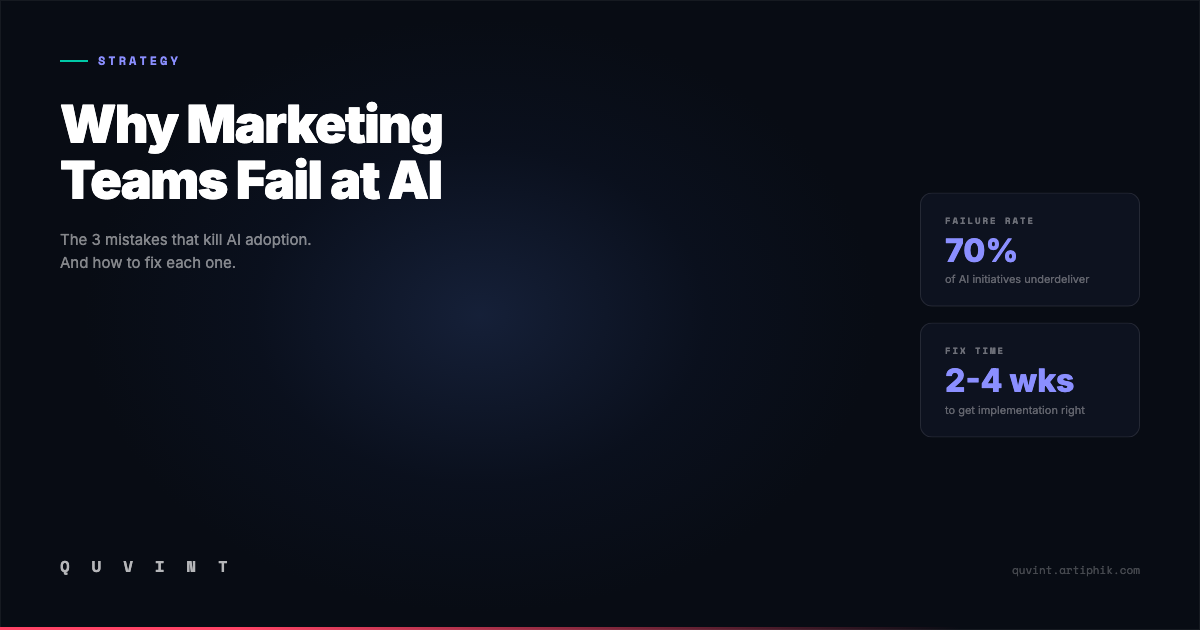
73% of marketing teams that adopt AI report disappointing results within the first 6 months. Not because the technology failed. Because the approach did. They bought tools, plugged them in, expected magic, and got mediocre output that their team had to redo anyway.
We build custom AI marketing systems for teams. We have seen what works and what does not. And the pattern is painfully consistent. The teams that fail make the same mistakes. The teams that succeed do three specific things differently.
This is not a post about whether AI works for marketing. It does. Teams using AI generate 129% more leads and launch campaigns 75% faster. The question is why some teams capture those gains and most do not.
Let’s break down why marketing teams fail at AI, and the three things that fix it.
The 5 Ways Marketing Teams Set Themselves Up to Fail
Before we get to the fixes, let’s name the failure modes. If any of these sound familiar, you are not alone. Nearly every team I talk to has fallen into at least two of these traps.
1. They Buy Tools Before Defining Problems
This is the number one mistake. A team hears about AI, someone signs up for three different platforms, and suddenly the team is trying to figure out what to do with them. The tool came first. The problem came second.
That is backwards. AI tools are solutions. If you have not clearly defined the problem, you are just adding complexity to your stack. You end up with another SaaS subscription that nobody uses after the first month. Sound familiar?
The right approach: map your workflows first. Find the bottlenecks. Identify where your team wastes the most hours. Then find the AI solution that fits that specific problem.
2. They Use Generic AI for Brand-Specific Work
This one hurts the most because teams feel like they gave AI a real shot and it let them down. They use a generic tool to write social posts or email copy. The output sounds robotic. Or worse, it sounds like every other brand on the internet.
Generic AI produces generic output. It does not know your brand voice. It does not understand your audience segments. It has no context about your product positioning or competitive landscape. So it does what any system without context would do. It produces average, safe, forgettable content.
The team revises the AI output so heavily that they question whether it saved any time at all. And they are right to question it. Bad AI implementation can actually cost more time than manual work.
3. They Try to Automate Everything at Once
Ambition kills AI projects. A marketing lead gets excited and tries to automate content, social, email, reporting, and competitive research all at the same time. Two weeks later, nothing works well. The team is frustrated. Leadership questions the investment.
The best implementations start with one workflow. Master it. Measure the time saved. Build confidence. Then expand. Trying to boil the ocean on week one is how you drown.
4. They Treat AI as a Replacement, Not an Amplifier
Some teams adopt AI with the mindset of “now we need fewer people.” That framing poisons the entire implementation. Team members resist the tools because they feel threatened. The people who should be teaching AI their expertise are instead hiding it.
AI does not replace marketers. It replaces the repetitive parts of marketing. The strategic thinking, creative instincts, and market intuition that make your team valuable are exactly the things AI cannot do. The best implementations position AI as a tool that handles the 60% of production work so the team can focus on the 40% that actually moves the needle.
5. They Never Measure the Baseline
If you do not know how many hours your team spends on content production before AI, you cannot prove AI saved time after. Most teams skip this step. Then when leadership asks “is this working?” the answer is “we think so, maybe.”
That is not good enough. Measure before you build. Track hours per workflow. Track content output per week. Track campaign launch timelines. Then compare. The teams that measure see clear ROI. The teams that don’t end up canceling the project because they can’t prove the value.
The 3 Things That Fix It
Now for the part that matters. After building AI marketing systems for teams and seeing what actually produces results, the fixes come down to three things. Not twenty. Not a complex framework. Three.
The 3 Fixes for AI Marketing Success
- Fix #1: Give AI your context, not just your tasks
- Fix #2: Start with one high-impact workflow and nail it
- Fix #3: Build systems, not tool collections
Fix #1: Give AI Your Context, Not Just Your Tasks
This is the single biggest difference between teams that get value from AI and teams that don’t. Context.
When we build AI systems for marketing teams, the first 2 to 3 weeks are not about the AI at all. They are about documenting the team’s context. Brand voice guidelines. Audience personas with real data. Product positioning docs. Past campaign performance. Content style guides. Competitive positioning.
A custom AI system trained on your brand voice, your audience data, and your competitive landscape produces output that sounds like your best marketer wrote it. A generic tool with none of that context produces output that sounds like a robot wrote it. Because functionally, it did.
The teams that invest in context building before implementation see dramatically different results. We are talking about the difference between AI-generated content that goes straight to publish and AI-generated content that goes straight to the trash.
Think of it this way. If you hired a new marketing manager and gave them zero onboarding, no brand guidelines, no audience research, and no context about your product, would you expect great work on day one? Of course not. AI is the same. Context is onboarding for AI.
Fix #2: Start With One High-Impact Workflow and Nail It
Forget the grand AI transformation roadmap. Start with one workflow. The one that eats the most hours on your team every week.
For most marketing teams, that is one of these:
- Content production (blog posts, social posts, email copy). Teams typically spend 10 to 15 hours per week here.
- Reporting and analytics (pulling data, formatting reports, writing summaries). Usually 4 to 8 hours per week.
- Competitive research (monitoring competitors, summarizing changes, tracking positioning). Usually 3 to 5 hours per week.
Pick the biggest one. Build a system for it. Measure the results. Most teams see 15 to 20 hours per week saved when they nail their first AI workflow.
Here is why starting small works so well. First, you get a quick win that builds organizational confidence. Leadership sees measurable time savings. The team sees their workload lighten. Second, you learn what works for your specific team before scaling. Every team has different dynamics, approval flows, and quality standards. Nailing one workflow teaches you how AI fits into your culture.
Third, and this is the one people miss, one successful workflow creates internal champions. The person whose weekly report now takes 20 minutes instead of 3 hours becomes your biggest AI advocate. That organic buy-in is worth more than any top-down mandate.
Then you expand. Workflow two is easier because your team already has the muscle memory. Workflow three is easier still. Within 8 to 12 weeks, you have a full AI marketing operation. But it started with one thing done well.
Fix #3: Build Systems, Not Tool Collections
This is where most teams plateau even after getting past the first two fixes. They end up with five or six AI tools that each handle one task. A writing tool. A design tool. A social scheduling tool. An analytics tool. None of them talk to each other.
The result is a fragmented stack where your team is still the integration layer. They are copying data between tools, manually connecting insights from one platform to actions in another, and spending time managing the tools instead of the tools managing the work.
The fix is building integrated AI systems where the components work together. Where your content strategy feeds into your SEO optimization, which informs your social distribution, which connects to your analytics, which loops back to your strategy. One system, not six disconnected tools.
This is exactly what we build for marketing teams. Not a collection of AI tools duct-taped together. A unified AI marketing system where everything is connected. Brand context flows through every output. Insights from one channel inform decisions on another. Your team interacts with one system, not seven dashboards.
Companies using integrated AI systems report 3.2x higher ROI after 24 months compared to those using disconnected SaaS tools. The integration is the multiplier. When AI tools share context, the quality of every output goes up. When they don’t, you are just running faster on a treadmill.
The Real Difference: Approach, Not Technology
Here is the uncomfortable truth that AI vendors don’t want you to hear. The technology is not the differentiator. The approach is. Two teams can use the exact same AI capabilities and get completely different results based on how they implement them.
The teams that fail treat AI like a vending machine. Put in a prompt, get out content. The teams that succeed treat AI like a new team member. They onboard it. They give it context. They start it on one project. They integrate it into existing workflows.
The technology is ready. It has been for a while. The question is whether your team’s approach is ready.
What This Looks Like in Practice
Let me give you a concrete example. A marketing team of five people spending 60% of their time on repetitive tasks. That is roughly 100 hours per week of automatable work across the team.
Before AI: The team produces 8 blog posts per month, manages 3 social channels with inconsistent posting, spends every Monday assembling reports, and falls behind on competitive research. The team is busy but not productive.
After implementing AI the wrong way: The team signs up for 4 different AI tools. They spend 3 weeks trying to make them work. Output quality is inconsistent. Half the team stops using the tools. The monthly subscription costs pile up. Net result: more frustration, same output.
After implementing AI the right way: The team documents their brand context over 2 weeks. They automate content production first, saving 15 hours per week immediately. They expand to reporting automation next, saving another 6 hours. By week 8, the team produces 20 blog posts per month, posts daily on 5 channels, and has automated reporting. Same team, same budget, 2.5x the output.
The difference is not the AI. It is the approach.
Start Here
If your marketing team has tried AI and gotten mediocre results, or if you are about to start and want to avoid the common traps, here is what I would do:
- Audit your workflows. Find the top 3 time sinks on your team. Measure how many hours they consume weekly.
- Document your context. Brand voice, audience data, product positioning, competitive landscape. This is non-negotiable.
- Pick one workflow. The biggest time sink. Build a custom AI system for it. Measure the results for 4 weeks.
- Expand from proof. Use the data from workflow one to justify and plan workflows two through five.
If that sounds like a lot to figure out on your own, it does not have to be. We build custom AI marketing systems for teams that want to skip the trial-and-error phase and go straight to results. The systems we build are trained on your brand, integrated with your tools, and designed to save your team 20+ hours per week from month one.
Book a free strategy call and we will walk through exactly where AI fits into your marketing operation, what to automate first, and what kind of results you can realistically expect. No pitch deck. Just a conversation about your workflows and where the biggest wins are.